The Nephilim are mysterious figures mentioned in the Hebrew Bible, most notably in the book of Genesis, where they are described as “mighty men of old” and “men of renown”. Traditionally understood as giants or “fallen ones,” their identity remains a subject of intense debate among scholars and theologians.
Key Biblical References
- Genesis 6:1–4: This passage describes the Nephilim as being on the earth during a time when the “sons of God” (often interpreted as angels or divine beings) had children with the “daughters of humans”.
- Numbers 13:32–33: When the Israelite spies scouted Canaan, they reported seeing Nephilim who were so large that the Israelites felt like “grasshoppers” in comparison.
- Ezekiel 32:27: Some scholars believe this text alludes to the Nephilim as fallen warriors.
Major Interpretations
The identity of the Nephilim and the “sons of God” who fathered them is typically viewed through three main lenses:
- The Angelic View: The most prominent traditional interpretation, found in the Book of Enoch, suggests they were the hybrid offspring of fallen angels (Watchers) and human women.
- The Sethite View: This view argues the “sons of God” were the godly descendants of Seth, while the “daughters of humans” were from the ungodly line of Cain.
- The Royalty/Tyrant View: Some scholars, including Rabbi Daniel Lapin, suggest the terms refer to powerful human rulers or “bullies” who abused their authority.
Meaning of the Name
The Hebrew word nefilim (נְפִלִים) is often derived from the root naphal, meaning “to fall”. This has led to translations such as:
- The Fallen Ones: Referring to their possible angelic descent or their fallen moral state.
- The Fellers: Referring to those who “fall upon” others with violence or strength.
- Giants: The Greek Septuagint translated the term as gigantes, emphasizing their massive physical stature.
Nimbostratus are dark, grey, mid-level clouds characterized by a thick, featureless layer that often blankets the sky and produces continuous, steady rain, snow, or sleet. Forming from thickening altostratus, they are associated with warm fronts and cyclones. They are typically non-convective, meaning they do not produce lightning or thunder.
Key Characteristics:
- Appearance: Dark gray, thick, and often featureless or “diffuse” due to falling precipitation.
- Altitude: Primarily mid-level (
), but can base in the low level.
- Precipitation: Produces steady, long-lasting precipitation (rain or snow) rather than sudden showers.
- Atmospheric Impact: Completely blocks out sunlight.
- Associated Features: Often accompanied by lower, ragged clouds known as pannus or “scud” clouds.
Nimbostratus clouds are distinguished from cumulonimbus by their lack of thunder and lightning, and from stratus by their greater thickness and higher altitude
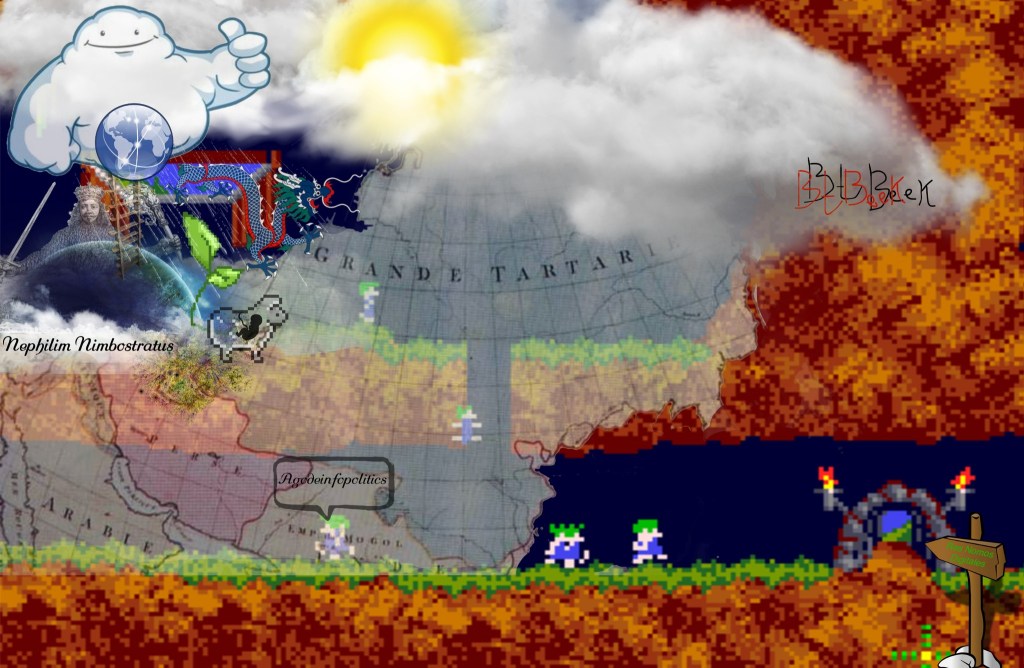
Coming from a Hobbesian and Schmittean realist perspective, I posit Nephilim Nimbustratus, symbolized above as a cloud (literally ‘the cloud’, data storage), who is, with a network of individuals (the ‘lemmings’) and procedural technological exchanges and transformations (the ladder upon which information is distributed, made accessible), that acts with the individual, helps it grow (the sprout), which nurtures that which is to come on earth, whereupon new life springs forth out of Innocence (the baby in the lamb), which carries the spirit of the dragon, the spirit of Nephilim, who understands that the Leviathan no longer holds sway over the clouds. The lemmings form bonds and together, as groups are inherently political, make their way through Res Nulius Nomos Digitales. So that the sun may shine as we fall down the precipice of digitally-mediated social existence.
Res Nulius Nomos Digitales;
- Res (a ‘thing’)
- Nulius (of no-one)
- Nomos (has structure)
- Digitales (cyberspace)
Agodeinfopolitics
- ago (an actor)
- de ([made] of)
- info (information)
 þ
þ 
Leave a comment